

Industrial Thermal Transfer vs. Direct Thermal: Which Should IT Teams Standardize On?
Thermal printers create text and barcodes by applying controlled heat, but the two main methods produce images differently. Direct thermal equipment activates a heat-sensitive coating on the label, while thermal transfer printers melt material from a ribbon onto the label surface. That difference affects durability, consumables, maintenance, and fleet design.
For IT teams supporting manufacturing plants, laboratories, warehouses, and distribution centers, industrial thermal transfer is often considered the safer standard for demanding applications. The method supports durable labels for assets, components, containers, and inventory that may face repeated handling or environmental exposure.
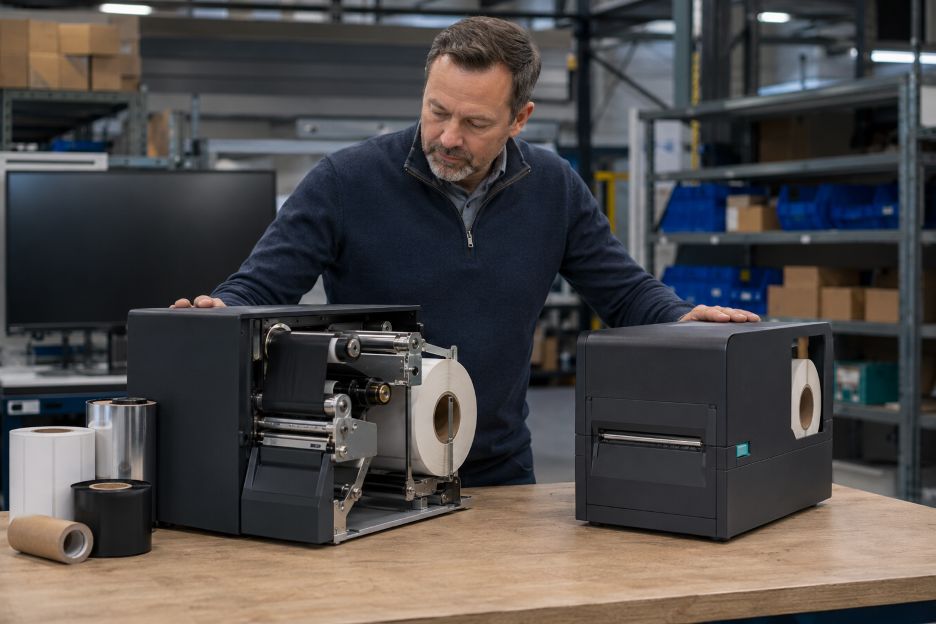
The Case for Thermal Transfer
Durability is the strongest argument for thermal transfer. Zebra Technologies explains that the heated ribbon forms a stable image on the selected label material. When the ribbon and label are properly matched, the result can resist moisture, heat, abrasion, ultraviolet exposure, and certain chemicals.
This resilience matters when labels must remain readable for months or years. Equipment identification, electrical components, laboratory samples, outdoor inventory, and permanent asset tags are common examples. A damaged barcode can interrupt scanning, complicate maintenance records, or disconnect a physical asset from its digital history.
Regulated environments add another consideration. The Occupational Safety and Health Administration requires workplace warnings on hazardous chemical containers to remain legible and prominently displayed. Printing technology alone does not guarantee compliance, since the adhesive, face material, coating, and exposure conditions also matter. Still, a durable ribbon-based image can provide a stronger starting point where labels encounter solvents, washing, sunlight, or frequent handling.
Thermal transfer also offers a wider choice of media. Paper may be sufficient for controlled indoor use, while polyester, polypropylene, vinyl, or polyimide can serve more demanding conditions. Ribbons are commonly available in wax, wax-resin, and resin formulations. Each combination changes cost, print quality, and resistance, so IT and operations teams must qualify the complete label system rather than approving a printer by itself.
The Case for Direct Thermal
Direct thermal presents an equally practical argument: simplicity. These printers do not need ribbons, toner, or ink. IT teams therefore have fewer consumables to purchase, store, distribute, and match with individual printer models. Operators also avoid ribbon-loading mistakes and production pauses caused by an empty or incorrectly installed ribbon.
A simpler supply chain becomes valuable across a large fleet. If dozens or hundreds of packing stations produce short-lived shipping labels, managing one media roll per device may be easier than maintaining compatible combinations of labels and ribbons. Fewer operating variables can simplify instructions, troubleshooting, inventory control, and technician training.
Direct thermal output can still provide sharp, scannable barcodes. GS1 identifies the method as suitable for shorter-life labeling applications and notes that both thermal technologies can produce one-dimensional and two-dimensional symbols. For shipping, receipts, visitor identification, picking operations, and other fast-moving workflows, long-term image stability may offer little practical value.
The tradeoff is sensitivity. Heat, strong light, abrasion, and certain chemicals may cause direct thermal stock to fade, darken, or become unreadable. Protective top coatings can improve performance, but they do not make every direct thermal label suitable for permanent identification. Storage conditions also matter because unused media remains heat-sensitive.
Why One Standard May Not Fit Every Site
The dialectic cannot be resolved by declaring one technology universally superior. The more useful question is whether the organization benefits from one fleet standard or a controlled two-tier policy. Three deployment factors usually reveal the answer.
- Label lifespan: Short-lived shipping and transaction labels favor direct thermal. Asset, compliance, product, and traceability labels generally favor ribbon-based printing.
- Operating environment: Heat, sunlight, moisture, cleaning agents, abrasion, and chemical contact increase the need for qualified durable materials.
- Printer count: A large, distributed fleet magnifies consumable-management costs, while a smaller group of specialized printers makes ribbon control more manageable.
Print quality should also be tested under real operating conditions. GS1 recommends verifier-based assessment because a barcode verifier evaluates symbol quality more thoroughly than an ordinary scanner. Pilot labels should be exposed to the expected temperature, handling, chemicals, and storage period before a technology becomes the organizational standard.
A Balanced Standardization Policy
Many IT departments will find that a policy-based standard works better than a single printer rule. Direct thermal can serve defined short-term workflows with limited environmental exposure. Thermal transfer can be reserved for durable identification, regulated labeling, outdoor use, chemical exposure, and records that must remain readable throughout an asset or product lifecycle.
Printer models should then be limited within each approved category. This approach supports consistent information technology management across common drivers, network settings, print languages, resolutions, and monitoring tools, even when both printing methods remain available. Approved media lists should specify the label, adhesive, ribbon, expected lifespan, and permitted environment.
The final decision should follow the label’s job. Direct thermal reduces consumable complexity and supports efficient temporary labeling. Thermal transfer adds materials and ribbon management but provides greater durability when failure carries operational or compliance consequences. By matching technology to lifespan, environment, and fleet scale, IT teams can standardize deliberately without forcing every workflow into the same technical solution.